
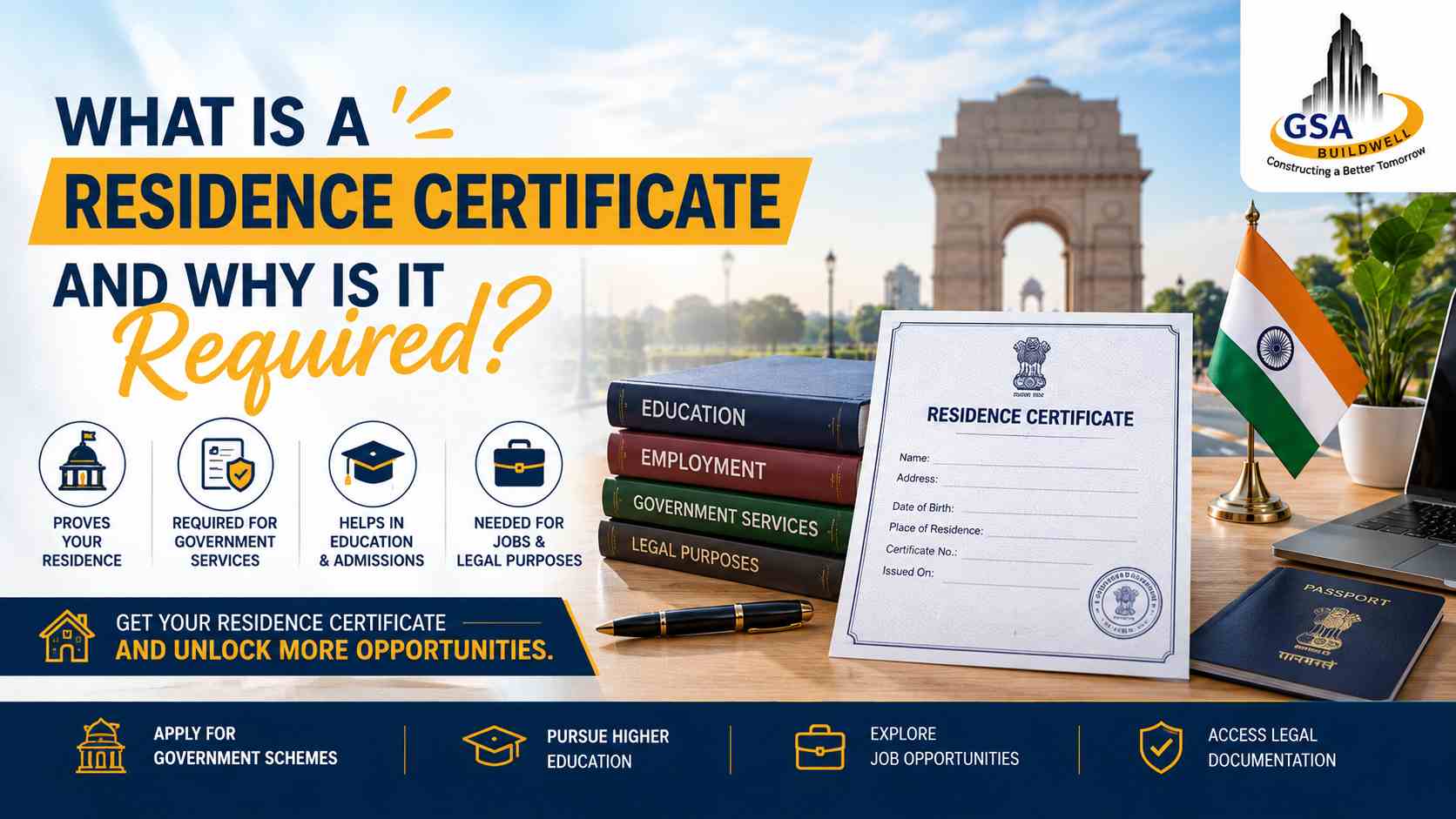
What Is a Residence Certificate and Why Is It Required?
When you apply for a government scheme, admission scholarship or certain state-level benefits, you might be asked to prove where you normally live, so this is exactly where the residence certificate comes into the picture. It is an official document used to confirm that a person is a resident of a particular state. They look good, as it is generally issued by the state or local government authority after checking the document submitted by the applicant. The exact name or the rules and documents might vary from one state to another. So if you are planning to apply for one, it is always better to ask or check the requirements of your state before submitting an application.
What is a Residence Certificate?
A residence certificate is a government-issued document that serves as proof of a person's residential status in a specific area. It is very important for you to understand that a residence certificate is not necessarily the same as an address proof like an Aadhaar card or electricity bill. These documents might be used as supporting evidence when applying for a residence certificate, but the certificate itself is issued by an authorised government authority. In some situations, you might also hear terms like domicile certificate or residential certificate. These terms can have different meanings depending on the state and the purpose for which the document is being used
Some common situations where residence or domicile-related proof may be required include:
- State government scholarships
- Educational admissions
- State-specific reservations or quotas
- Government welfare schemes
- Certain government jobs
- Fee concessions
- Local benefits and schemes
- Applications where state residency is an eligibility condition
Who can apply for a residence certificate?
Eligibility depends on state rules or the issuing authority. Generally, the applicant needs to demonstrate that they have been residing in the relevant state or the area for a specific time under the applicable rules. For children or minors a parent or legal guardian might sometimes apply on their behalf. Some states also have specific rules for people who have recently moved, students or government employees.
What Documents Are Usually Required?
Commonly requested documents may include:
- Aadhaar card or another identity document
- Address proof
- Passport-size photographs
- Proof of date of birth
- Utility bill or other residential document
- Rent agreement, where applicable
- School or college records, where relevant
- Self-declaration or application form
Is a residence certificate the same as a domicile certificate?
Not always. This is one of the most common points of confusion. A residence certificate generally confirms that a person resides in a specific area. A domicile certificate, depending on the state's rule, can be used to establish a person's permanent or legally recognised domicile for specific purposes. The terminology and legal use can vary between Indian states. Therefore, if your application specifically asks for a domicile certificate, don't assume that a general residence certificate will automatically be accepted.
So you need to know that a residence certificate is an important document where you need to establish your residential status for a government- or institution-related purpose. It can be used in areas like education, scholarships, government schemes and other applications where state or local residency matters.